'Dairy copping it every way': cost hikes fuel calls for loan scheme expansion
As the price and availability of fuel and fertiliser continues to be a concern and eating into the bottom line of farmers, South Australian dairyfarmers have called for a low interest drought loan scheme to be broadened to help counteract the financial hit.
Under the $200m SA Drought Loan Scheme announced by the state government in February, only farmers in council areas in the Murray Mallee, Riverland and Upper North regions were made eligible.
South Australian Dairyfarmers' Association president Robert Brokenshire said while the organisation supported the drought loan scheme in principle, it had flaws and needed to be broadened.
"It's a statewide drought," Mr Brokenshire said.
"It's not a drought that only occurred in occurs in the Mallee, Riverland and in the upper Mid North.
"There's a fundamental flaw in the policy at present that most of the farming areas are not even eligible to apply."
Eligible council areas include Karoonda East Murray, Mid Murray, Southern Mallee, Coorong, Murray Bridge, Renmark Paringa, Berri Barmera, Loxton Waikerie, Orroroo Carrieton, Peterborough, Northern Areas and Mount Remarkable.
Mr Brokenshire wrote to the Premier following the announcement expressing his concern. He is still awaiting a response.
"Dairy is copping it every which way at the moment, with the drought, with the input costs for fuel, fertiliser, and the fact that we need fuel, no matter the cost of it, to operate a dairy every day," Mr Brokenshire said.
"We are very concerned about the current situation.
"Some (farmers) are reducing stock numbers so cows that they might have kept for another lactation, some are selling.
"Others have been selling young stock to create cash flow to keep going and that's a short-term solution because at some point you need young stock to replace your older cows."
Mr Brokenshire says the dairy industry is worth $1 billion a year to the state's economy, is a huge employer and processors are calling for more milk.
"We're appealing for a change in policy for the $200 million drought package to include all South Australian farming areas, because there isn't one that isn't copping the effect of the drought and on top of that now all these out of control input costs."
Michael Connor, a dairyfarmer of more than 50 years whose family operation Nangkita Dairies runs two robotic dairies at Mount Compass and Mount Jagged on the Fleurieu Peninsula, said he hadn't experienced consecutive dry years like those of 2024 and 2025.
Some of the Nangkita Dairies herd heading back to the paddock after milking. Picture by Quinton McCallum
They have felt the impacts of the dry and while they grow their own feed, they also rely on buying in fodder for their herd of 800 Holsteins and Jerseys.
Mr Connor questioned why regions would be excluded, when each felt the impact of the drought in different ways.
"As dairy farmers we trade, we buy feed out of drought-affected regions and it's just an obvious slip up by the government, I think. I think it's very short-sighted," Mr Connor said.
"What could be a good program should be a statewide program.
"I can't think of a reason why it shouldn't be."
Over the past two years, the Connors have bought $800,000 worth of feed and if it weren't for a well-timed rain event in October, which allowed them to cut silage, Mr Connor said they might have a different story to tell this year.
Usually a high-rainfall area, the home farm has only had 44 millimetres in 2026 to date, which is in stark contrast to northern parts of the state who have had a soaking start.
"If it wasn't for that (rain in October last year), I don't know where we'd be now, we wouldn't be operating the way we are now," Mr Connor said.
Michael Connor, Nangkita Dairies, is backing SADA's call to expand the SA Drought Loan Scheme beyond the three regions eligible. Picture by Quinton McCallum
The SA Liberals have come out in support of the dairy industry's call, with spokesperson for Primary Industries Nicola Centofanti saying rising input costs were placing enormous strain on them.
"Everything that goes into keeping dairy cows healthy and productive is becoming more expensive," Dr Centofanti said.
"From fertiliser and fuel to polypipe, these essential inputs have surged in price, driven in part by the conflict in Iran.
"These costs add up - and ultimately they are passed on at the supermarket checkout."
A state government spokesperson said the SA Drought Loans Scheme was indeed open to dairyfarmers (albeit in the council areas listed) and was taking currently applications from drought-affected farmers.
"We are continuing to monitor the economic and environmental pressures impacting grain and livestock farmers wherever they are in South Australia, and will respond as necessary to support them," the spokesperson said.
The spokesperson said a fuel security roundtable had also been established, chaired by the Premier and comprising various industry stakeholders, including primary industries, to try minimise the situation's fallout.
"The Commonwealth and state governments are constantly assessing and responding to the situation around fuel security and the supply chain," the spokesperson said.
"In recent days the Commonwealth and state government have cut the fuel excise in half, which will reduce the prices of diesel and petrol across the country by 26.3 cents per litre.
"Our government has stepped in to take fuel cost reductions even further, directing a $40 million GST revenue windfall to reduce the cost of diesel and petrol in South Australia by a further 5.7 cents per litre - equalling a 32 cent per litre reduction in the coming weeks."
Further Information
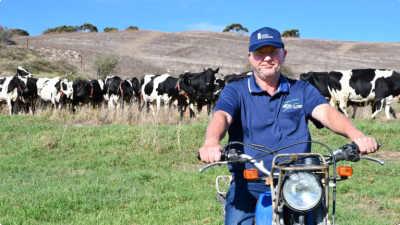
Michael Connor, Nangkita Dairies, is backing SADA's call to expand the SA Drought Loan Scheme beyond the three regions eligible. Picture by Quinton McCallum
By Chelsea Ashmeade | April 7 2026
Channel 7 News: South Australian farmers pushed to the brink by soaring fuel costs are demanding more support from the state government.